
Fiat Money: The Fragile Foundation of Modern Finance
In today’s financial system, fiat money is the standard medium of exchange—but it’s a far cry from the sound money principles that once governed economies. The worth of a fiat currency depends entirely on trust in the government that issues it. This trust-based system gives governments unprecedented control over money—how much exists, who gets it, and how it circulates. But with great power comes great risk: inflation, devaluation, and economic instability.
How Fiat Money Works (And Why It’s Flawed)
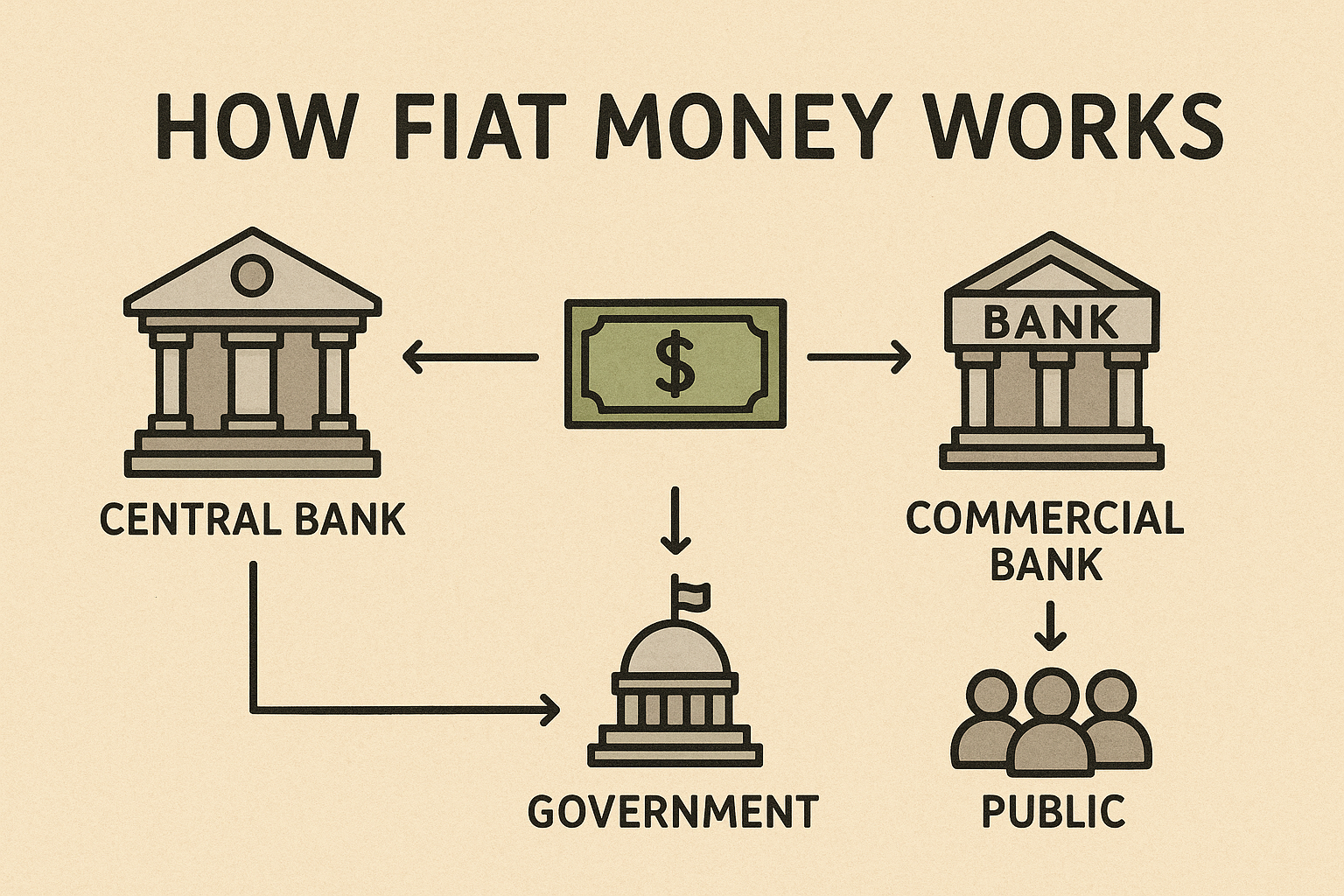
Fiat money operates on a simple premise: people accept it because others do. Governments declare it a legal tender, and banks enforce its use. For example, the United States Dollar (USD) was declared to be used in global reserves as a currency of exchange between it with other fiat money. But since it’s not tied to any real asset, its value is entirely subjective—backed only by laws and collective belief. But if confidence drops (due to hyperinflation, political instability, or economic crises), the currency can collapse—examples include the Zimbabwean dollar and Venezuela’s bolívar.
The Dangers of Government Control
Central banks and governments dictate the money supply, meaning they can:
- Print unlimited amounts of currency (leading to inflation).
- Manipulate interest rates to stimulate or slow down the economy (monetary policy).
- Bail out failing institutions by creating new money out of thin air.
- Regulating banks to stabilize the economy.
This centralized control creates systemic vulnerabilities:
- Inflation erodes savings—what $100 can buy today may only be able to buy goods worth $80 in a few years.
- Debt spirals out of control—governments borrow endlessly, knowing they can print more to cover deficits.
- Financial crises become inevitable—artificially low interest rates and reckless money-printing distort markets.
The Inflation Trap
Inflation is a hidden tax on everyone who uses fiat money. When governments flood the economy with new currency, prices rise because the money itself loses value.
- Real-world impact: Wages often lag behind with prices increasing gradually, meaning people get poorer over time even if their paycheck numbers go up.
Fiat Money vs. Sound Money Principles
Historically, money was scarce and durable—gold and silver couldn’t be printed at will, so they preserved value across generations. Fiat money can be printed at will which is demonstrated by different governments. Different governments have different forms through which their fiat money is represented on international markets. Some examples of Fiat money include Kenyan Shillings (KES), United States Dollar (USD), British Pound (GBP), etc. However, by contrast, fiat money is designed to decay.
The Future of Money: Beyond Fiat
Fiat money fuels short-term growth but sacrifices long-term stability. As debt piles up and inflation accelerates, people worldwide are searching for alternatives—currencies that can’t be devalued by government decree.
Bitcoin, with its fixed supply of 21 million, offers a solution: money that no central authority can manipulate. Unlike fiat, Bitcoin’s scarcity is mathematically guaranteed, making it inflation-proof.
Why This Matters for the Next Generation
- Fiat money rewards debt and punishes savers.
- Bitcoin rewards long-term holders and resists manipulation.
- The choice is clear: Stick with a broken system or opt for sound money.
🚀 The era of fiat dominance is ending. Will you be ready? ⚡